
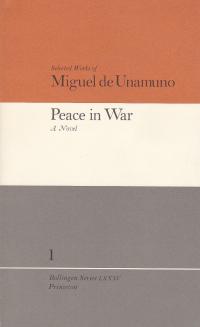
The appearance of this work is that of a major war novel, in the style of War and Peace. But individual episodes are lacking, as they give way to collective events. It is, indeed, a novel of collectivity, and Juan Pablo Fusi highlights this in his introduction to the Alianza edition, where he attempts to show that Unamuno here expressed fully his conception of the Basque people and, in particular, of Bilbao, a Basque, Spanish, and liberal city.
But the novel may go beyond these limits and become part of Unamuno’s worldview; that is, we may not be speaking only of Basques and Spaniards, but of human beings. This seems confirmed by the final pages, which explain everything we have witnessed over the previous three hundred pages: war does not substantially alter human life, which continues in its peace, in its labors and days, above the contingencies of politics or its continuation by other means.
In a way, Peace in War is the gateway to Unamuno’s “nivolas,” with their singular characters who embody an “agony.” It seems clear that the only war is life itself, and in this sense there is not much difference between a wartime situation and a peaceful one. This is the general framework, the context upon which all the great Unamunian creations—Abel Sánchez, The Tía Tula, or San Manuel Bueno, Martyr—later express their own way of being.