
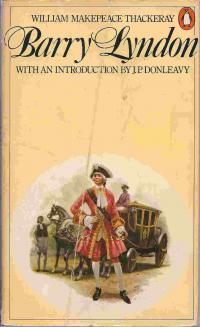
Barry Lyndon is a story of some fictitious memories and, at the same time, a picaresque and satiric novel based on history. It narrates the rise and fall of the overly ambitious Redmond Barry, a young Irishman, who was bent on becoming a rich and important man. He enlisted in the British army and was part of the Seven Years War. Soon he deserts the British Army and was recruited by force by the Prussian army. Much later, he met his uncle, a gentleman who trained him in the art of fraud, and along with this he engaged in fleecing the aristocrats of the European courts. Barry, a hypocrite, a social climber and a vain person, uses all sorts of tricks so as to scale up the good society of the 17th century, until he got married to Lady Lyndon, a rich widow from whom he took the surname Lyndon.
Thackeray, master of irony and psychology, created one of the most emblematic scoundrels of the history of literature in this novel. The first edition (1844), published in parts, was not highly valued by readers, that they complained of “the immorality of history”; the author felt obliged to add paragraphs, digressions, and explanations in order to justify his ironic way of acting and to clarify his intention. Almost all addenda were abandoned in 1856, when Barry Lyndon was again published.
The protagonist, a rogue gifted with a destructive and sarcastic spirit, was used by Thackeray in order to ridicule the defects and pretensions of the higher classes of his times. According to Barry, the perfect gentleman is disgraceful, also publicly praised for his dishonesty and lack of integrity. In any case, the author never presents his character as a model, but he had wanted that he be more than a simple foreigner. His career (the war, the game, the marriage) mimics true aristocratic career, and their vices (brutality and harshness, arrogance and ignorance, laziness and drunkenness) which predisposed him to this nobility of momentary self satisfaction. We have to add to all these qualities, a misogyny which appears starting from the first page: taking advantage of women is, for this rouge, a way of paying back for the faults of the daughters of Eve; the story always resorts to ellipsis and euphemisms on this point. Lastly, the novelist is nevertheless cruel with Barry and he punishes him turning his own weapons against himself.