
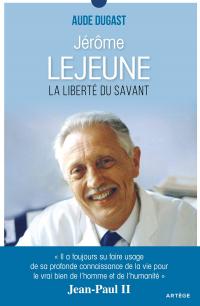
The death earlier this year of Birthe Lejeune, widow of Jérôme, the French pioneer of modern genetics, has brought a renewed focus on both their lives. Their daughter’s book on her father (Clara Lejeune-Gaymard, Life is a Blessing) is available in English, but Jérôme Lejeune (1926-1994) should nevertheless be better known in the English-speaking world. While two major biographies have been published in French, there are not as yet any translations in English. However, this fine 2019 publication by Aude Dugast is due to be translated in 2021 and follows on an excellent earlier biography in 2004 by Anne Bernet, which included extensive detail, for example, on Lejeune’s early years and family background.
Aude Dugast is also the postulator of his cause for canonization, the process for which began in his Paris diocese in 2007 and was completed in 2012, at which point he was given the title of Servant of God. The Roman stage of the process began in 2013 and the ‘Positio’ document drawing together information about Lejeune’s life, virtues and reputation was presented to the relevant Roman congregation in 2017 by Dugast. The process will continue in the coming years in Rome. In early 2021, Lejeune was declared ‘Venerable’ by Pope Francis.
In preparing this biography, Dugast thus had privileged access to his papers as well as extensive contacts with his family, colleagues and friends. As she makes clear, Prof Lejeune is best-known as the man who, with two other researchers, discovered the chromosomal disorder responsible for Down Syndrome or Trisomy 21.
Taking as his motto the phrase from chapter 25 of St Matthew’s Gospel - ‘as you did it to the least of my brethren, you did it to me’ - Lejeune had a great love for, and commitment to, his Down Syndrome patients and a strong sense that his vocation in life was to find a successful therapy for Down Syndrome. Whatever his other commitments, he always gave priority to consultations with his Down patients and their parents. He was later dismayed to find that his research breakthrough on the cause of Down Syndrome was being used to eliminate unborn babies with this syndrome.
Together with his brothers Philippe, an accomplished painter, and Rémy, Jérôme was the son of Pierre Lejeune, a businessman from the Paris region, and his wife Massa. While still a medical student at the Sorbonne, he had a love-at-first-sight encounter with a Danish student of French, Birthe Bringsted, in a Paris library in 1950. They were later to share a very happy family life with their five children - family summers included a marathon annual trip by car from Paris to the Danish seaside!
Jérôme was something of an absent-minded professor and sometimes left his family on holidays in Denmark to return to work in Paris while carrying the keys of the family car in his pocket on the train – leading to frantic efforts by his wife and Danish train officials to track him and the keys down at various Danish train stations before he left the country! After the death of Jérôme, Birthe continued supporting his work through the Lejeune Foundation (fondationlejeune.org).
The biographer presents Lejeune’s life as one of whirlwind activity, balancing his family life, treatment of patients with Down Syndrome, scientific research, teaching, speaking at international medical conferences and, in later decades, his defense of the right to life of the unborn, particularly the unborn baby with a handicap. Lejeune comes across in the biography as a person of warmth, humour and exceptional intelligence and also as someone of deep Catholic faith and rare courage. He thus calmly continued his work as a university professor, in spite of student opposition, during the chaotic student revolt of May 1968 in Paris. The following year, he spoke with remarkable courage against pre-natal diagnosis and abortion of the handicapped at a meeting of the world’s leading geneticists in San Francisco (“To kill or not to kill, that is the question”). Although he was being awarded the prestigious Allen Memorial Prize at the event, his address was met with an icy and eerie silence.
He later campaigned very strongly on TV and in public meetings against the legalisation of abortion in France in 1974. He galvanised French medical opposition to the proposed law, with some success at first, but he and his colleagues were ultimately unable to prevent the introduction of the abortion law and he was himself subjected to considerable abuse and indeed threats during that turbulent period. Lejeune travelled the world extensively, speaking at both scientific and pro-life conferences. I remember his powerful address in a distinctive French accent at a pro-life conference in Dublin thirty or more years ago, when he reminded his listeners of the words of Matthew’s Gospel cited above.
He was first President of the Pontifical Academy for Life, established by St John Paul II in the 1990s. From 1974, he was a member of the Pontifical Academy for Sciences. He had a deep involvement in the area of nuclear disarmament and was an envoy of Pope John Paul to the Soviet authorities in the early 1980s, setting out the grave dangers of a nuclear war. Dugast’s book begins by recalling that when Pope St John Paul was attending World Youth Day in Paris in 1997, he insisted, against some opposition, on visiting the grave of his ‘brother Jerome’, who had died from cancer on Easter Sunday, 1994. Immediately following Lejeune’s death, the introductory chapter also notes, John Paul had sent to Cardinal Lustiger of Paris a meditation on Christ’s words: ‘I am the resurrection and the life. Whoever believes in me, even if he dies, he will live’ (Jn, 11,25).
The Pope called attention to the day of death of this ‘ardent defender of life’: ‘If the Father who is in heaven called him from this earth on the very day of the Resurrection of Christ, it is difficult not to see in this coincidence a sign…Enlightened by these words of the Lord, we see the death of every human person as a participation in the death of Christ and in his Resurrection, especially when a death occurs on the very day of the Resurrection’.