
The Happiness Hypothesis
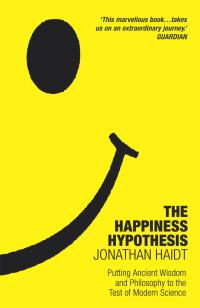
Jonathan Haidt (1963), a New York social psychologist, published this book in 2006, and the present edition (2026), introduced by José Luis Izquierdo, known as “Mago More” on social media, presents both as well-known popularizers of positive psychology.
In this essay, the author, drawing on extensive bibliographical references from Greek philosophers such as Plato and Aristotle; diverse writers such as Marcus Aurelius, Montaigne, and Machiavelli; Freud, Franklin, B.; and masters of ancient religions such as Buddha, Muhammad, Confucius, Jesus Christ, etc., etc., as well as numerous contemporary psychologists—all treated on the same level—argues that ancient wisdom and modern psychology do not contradict each other but rather complement one another. He also offers the reader, in his view, a more complete concept of happiness and some tools to guide them toward its attainment. The author concludes with what he understands as the meaning of life and proposes a redefinition of happiness that is not easily grasped.
Haidt first explains what he understands as the human mind and how it works: “it is divided into parts that sometimes come into conflict”; “... it is divided into four parts, the fourth being the most important” (mind versus body; left versus right; new versus old; controlled versus automatic). To explain his theory, he uses the metaphor of the rider and the elephant: “... since it best fits the fourth,” with the rider representing reason and the elephant representing emotions.
The content of the essay is engaging (happiness) but delicate and complex, as the author seeks to elevate the reader through the topics he addresses (mind, morality, passions, reason, emotions, etc.), but, as he openly states, he is an atheist, and his reflections are based on biology, evolutionary theory, positive psychology, and culture. In this sense, it may appear paradoxical and disconcerting for readers unfamiliar with the authors he cites, as well as dense if one is not acquainted with these fields.
A well-intentioned book that alludes to human spirituality but mentions it without fully embracing it. On the other hand, by basing his essay mainly on evolutionary ideology, positive psychology, and culture, and with such a mixture of authors, it may become somewhat cumbersome and also confusing in certain reflections, interpreting concepts such as morality in a subjective way.